Leave the Drum Fills at Home
Finish every drum fill, pad entrance, and bass movement before rehearsal and you give the band a karaoke assignment: reproduce the bedroom recording. The demo’s accents become instructions before anyone has felt the song move through a room.
I start by deciding what to leave unfinished: keep the chord movement and sung contour; leave the rhythm section somewhere to go.
That choice carries a real risk. Two chords and a mumbled melody invite the drummer’s pocket and the bassist’s ear into the writing. They also expose a fragile emotional impulse to whoever plays loudest or argues fastest. A close, uneasy verse can become a heavy psych workout before the singer finishes explaining its shape.
Three things keep that opening useful:
- A firm harmonic anchor: everyone can hear where the chord cycle returns.
- A shared time for critique: the band plays long enough to understand the sketch before debating it.
- Explicit lyrical authority: everyone knows who can approve or reject changes to the words.
For a working sketch, try an E-minor-to-C loop with the vocal resolving over E minor. The melody can hang in the air while the chord cycle remains clear. Leave the bass movement unwritten and the chorus texture undecided.
Then give the room a playable brief: “Keep the verse close and uneasy; let the chorus widen without getting faster.” That sentence gives the band something more useful than “make it bigger.” It names the feeling and the boundary.
Pack a Chord Anchor, a Vocal Shape, and a Turn
An open sketch needs a destination. An unfocused jam can circle a pleasing sound indefinitely; a song sketch needs an emotional pace and an audible change of state.
Stay with that E-minor-to-C loop. As an illustrative starting point, choose a 76–84 BPM pulse, an eight-bar verse, and a two-bar held chord before the chorus. Those choices give the players a transition to interpret. The held chord becomes a doorway rather than another patch of floor.
Keep the Long Vowel
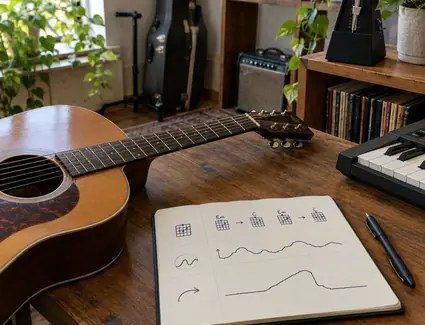
Write down the vowel on the melody’s longest note. An open “ah” and a rounded “oo” shape the phrase differently. In lo-fi and psychedelic rock, the sustained vocal can carry the emotional outline while fuzz and cymbals blur the consonants.
Keep that contour intact even if the lyric remains a mouthful of temporary syllables. A finished rhyme can wait; the singer’s entrance and the place where the note opens need to be audible.
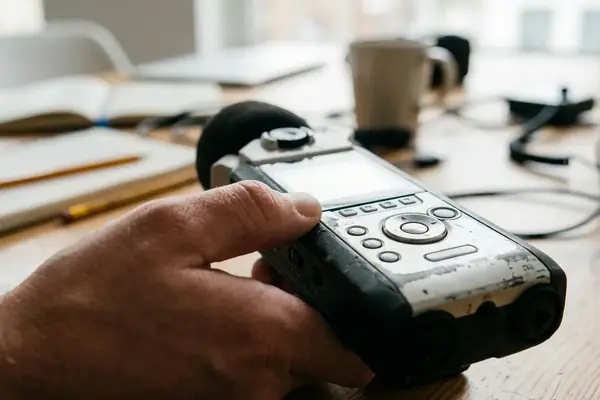
- Make a short reference. Try a 30–60-second voice memo containing the central progression, vocal contour, and transition. Use it as a rehearsal tool.
- Demonstrate the space. Allow roughly 2–3 minutes to play the memo once, then repeat the phrase live while marking the pulse.
- Name the rests. If the idea starts with a fuzz riff across beats one and two, leave beats three and four empty. Ask everyone to hear that gap before adding a part.
Those silent beats carry anticipation. Letting a fill occupy them immediately changes the sentence the riff was speaking. Present the simplest accompaniment that preserves that sentence, then invite the band inside it.
Hear the Pocket Without Losing the Song
A drummer’s contribution can make a difficult bridge feel inevitable. Carrying an existing pulse across the entrance gives the listener continuity while the harmony turns. A bass response can connect the chord roots and make the same change legible without another guitar layer.
This is the reward for bringing the song early: another player can hear movement where the writer has been staring at a join.
The danger arrives when volume starts making aesthetic decisions. A quiet sketch picks up a wall of distortion, the drummer follows its weight, and soon every section speaks in the same heavy accent. The playing may feel good under the hands while the original tension disappears.
Protect the Empty Beats
Return to the fuzz riff. If fills swallow its two silent beats, listen for what disappeared: the little intake of breath before the phrase returns. A contribution earns its place by developing that anticipation or giving it a deliberate answer.
- Keep: a bass response after the vocal that leaves the singer’s pickup clear.
- Examine: cymbal wash covering the held note, or distortion hiding the chord tone that gave the loop its uneasy color.
- Describe precisely: a snare behind the pulse changes the feel without requiring a tempo change. “More energy” leaves everyone guessing.
Capture 20–40 seconds of the same transition in each version, keeping the recorder’s position and gain unchanged. Listen at a consistent, comfortable volume. Ask which version makes the chorus land while preserving the exposed vocal.
That comparison reaches deeper than the vocabulary of record reviews. “Raw,” “dreamy,” and “heavy” describe an impression; the recording lets the band locate the entrance, rest, or chord tone producing it.
Give the Sketch Three Passes Before the Debate
Agree to three uninterrupted passes before anyone critiques the arrangement. Make that agreement before the count-in, while everyone can still hear ordinary speech.
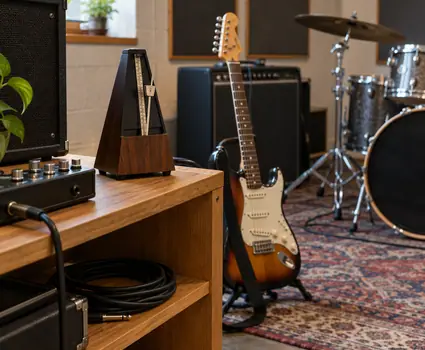
Start the melody demonstration with amplified instruments muted. Bring them in individually so the vocal and quieter chord voicings have time to register. Once the full kit enters, use a vocal microphone and adjust the ensemble around intelligibility. Asking the singer to shout changes the delivery you came to arrange.
- Find the route. On the first pass, locate the progression and its transition. Keep the recorder running through uncertain entrances.
- Settle the entrances. On the second, listen for when each part arrives and which register it occupies.
- Hear the whole arrangement. On the third, follow the song through without stopping to repair each rough edge.
For a sketch lasting 2–4 minutes, that means 6–12 minutes of playing before discussion. Useful mistakes need somewhere to survive besides memory.
Ask About the Ride
Afterward, give the first feedback exchange a proposed 3–5-minute boundary. The writer asks a specific sonic question: “Can you still hear the held vocal when the ride cymbal enters?” Or: “Does the chorus feel slower when the bass switches to sustained notes?”
These questions direct attention toward a shared sound. “What do you guys think?” can invite a referendum on the entire song while its transition is still taking shape.
Change one identifiable feature for the next pass: the bass register, guitar sustain, or drummer’s subdivision. Label the recording with that change. Keep any accidental entrance worth revisiting.
The protocol leaves room for surprise while keeping the comparison clear. The band can wander inside the phrase without moving every boundary at once.
Set the Lyric Veto Apart From the Writing Split
Creative authority and ownership need separate conversations. Authority to reject a rewritten chorus does not determine who owns a newly contributed bass melody or the recording made in the rehearsal room.
The U.S. Copyright Office circular on musical compositions provides a starting point for understanding the composition: its music and accompanying lyrics. A sound recording fixes a performance and is a separate work. Musical arrangements can also contain qualifying new authorship without transferring ownership of the underlying material.
For U.S. ownership decisions, assess the contribution’s original expression and the applicable agreements rather than its prominence in rehearsal.
“Writing a part” and “writing the song” are useful rehearsal shorthand. An iconic bassline or guitar hook deserves a specific discussion about its contribution; so does a change to the foundational structure. Loudness, repetition, and confidence settle neither question.
Write Down the Boundaries
Reserve 5–10 minutes before the first collaborative arrangement session to agree on who approves lyrics, who resolves arrangement disputes, and how anyone proposes a songwriting share. Record those decisions in plain language.
When a substantial hook or new section appears, try circulating the dated rehearsal recording and a contribution summary within 24–48 hours, while memories remain fresh. Treat that interval as an administrative habit. Document composition shares separately from master-recording ownership.
Give the original writer an explicit arrangement veto if that is the band’s agreement. Then describe how everyone will address contributions already made when that veto gets used. Clear boundaries let people offer something vulnerable without guessing what acceptance means.
For the rough track sitting in your voice memos right now, are you holding it back to protect its core identity, or to avoid hearing that the chorus isn’t there yet?