What a Fee-Waived Friday Actually Delivers to an Underground Catalog
Mismanaging a Bandcamp Friday means trading sustainable catalog listeners and shipping sanity for a fleeting, exhausting 24-hour cash bump that burns out your mailing list. For a Far West Texas micro-label, a fee-waived sales day can fund the next duplication invoice or turn a short cash surge into an unpaid packing shift. Bandcamp Friday excels at financing pressing costs and clearing deadstock cassettes or vinyl, yet it fails to build long-term listener retention on its own.
Operating a small imprint like Santa Rosa Records, an independent record label attuned to the echoes of Far West Texas and the static of lo-fi bedroom recordings, requires separating promotional hype from ledger reality. The promotional window has historically run from 00:00 through 23:59 Pacific Time on designated Fridays, governed by the provider's published calendar rather than an automatic monthly schedule. Within that 24-hour perimeter, three operational realities dictate whether a campaign succeeds:
- Immediate artist payout mechanics: High-velocity digital and physical checkouts require strict separation between gross receipts, surviving processor fees, and recoupable production advances.
- The physical fulfillment bottleneck: A sudden surge in orders compresses days of manual tape and vinyl packaging into a single weekend.
- The Saturday morning silence: Once the clock passes midnight Pacific, transactional urgency evaporates, leaving behind a quiet storefront if no editorial narrative supports the audio.
Before broadcasting a dispatch to followers, the label must start with the specific invoice that needs paying. For a proposed campaign, staff should reconcile existing stock and packaging supplies during the 7 to 10 calendar days before the promotion, reserving the following Saturday and Sunday strictly for picking, packing, and exception handling. When the checkout window closes, the order report must be separated into five distinct columns: digital purchases, physical purchases, shipping collected, payment fees, and artist liabilities. A postage payment belongs in the shipping budget, never the pressing fund.
Fee Waivers, Split Payments, and the Mechanics of Artist Payouts
Break the Friday checkout total into the cassette's waived platform share, surviving processor charge, recoupment ledger, and postage envelope before calling it pressing money. Tracing a single physical sale from the listener's cart to the artist ledger reveals how thin margins behave on low-run formats like hand-dubbed ferric cassettes and lathe-cut records.
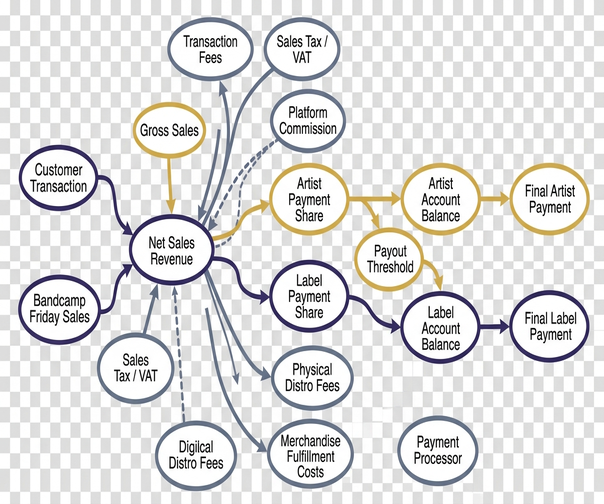
According to Bandcamp's official Bandcamp Friday documentation, the platform's published standard revenue share for physical merchandise has historically stood at 10%. On an eligible $12 cassette sale, waiving that platform share preserves $1.20 before payment-processing charges. That $1.20 represents raw transaction arithmetic rather than a guaranteed profit margin. Payment-processing charges remain payable during fee-waiver promotions, meaning the label accountant must work from the actual transaction statement rather than treating the advertised platform waiver as a completely fee-free checkout.
Reconciling Advances and Split Payments
The payout sequence depends entirely on the payment route and the signed artist agreement, as neither a platform fee waiver nor an automated split-payment feature automatically calculates a label's recoupable advances. When a small imprint fronts the capital for analog stem mastering, lacquer cutting, or shell printing for touring psych-rock bands, manual accounting remains mandatory.
- Isolate the merchandise baseline: Record the net item price separately from shipping charges and applicable territorial taxes on Saturday morning when exporting Friday's orders.
- Deduct surviving processor fees: Subtract the payment gateway assessment from the gross settlement.
- Apply the artist agreement: Review deductions and recoupment during the next 2 to 3 business days, identifying which mastering or tape-duplication advances are recoupable, which have already been recovered, and what net balance is payable to the musicians.
- Log the settlement: Record the actual funds transfer date separately from the original Friday sale date to keep seasonal royalty statements accurate.
Comparing a Friday digital discography bundle against streaming royalties shows a sharp structural divide. A digital discography purchase clears at checkout without adding a cardboard mailer or postage obligation, injecting immediate working capital into the label account. Streaming income arrives through delayed usage reporting and distributor accounting cycles; attempting a universal per-stream comparison obscures differences across playback services, listener territories, and distribution agreements, though the velocity of a direct download bundle clearly outpaces algorithmic trickle.
Cardboard Mailers, Postage Rates, and the Trap of Collector Fatigue
Corrugated cardboard dust coats the wooden sorting table by Sunday afternoon, accompanied by the sharp chemical scent of adhesive packing tape and thermal printer labels. Stacks of 12-inch whiplash mailers and snug Norelco tape boxes rise beside the postal scale while international customs declarations await harmonized tariff codes. Underestimating this physical bottleneck turns a celebratory sales spike into solitary warehouse exhaustion.
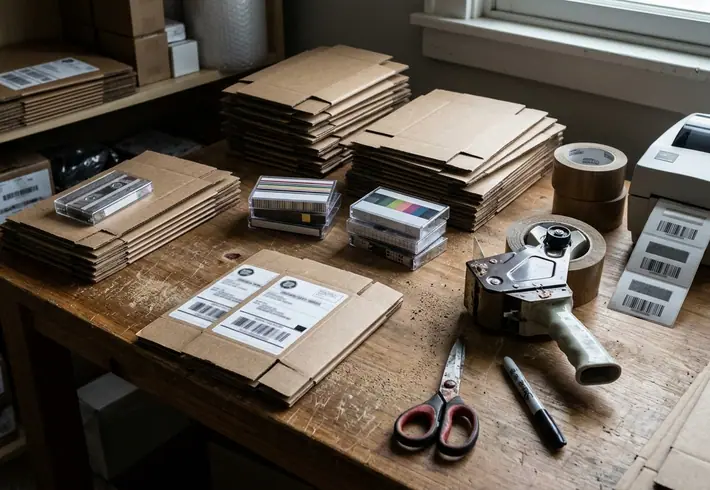
Before sending a promotional email, a label operator must walk through the entire physical job: locate each record on the shelf, inspect its outer sleeve for seam splits, match the packing slip, assemble corner protection, weigh the sealed parcel, purchase postage, and transmit tracking data. In an illustrative workload—a procedural model rather than a reported label result—36 parcels requiring five minutes of handling each demand three hours of uninterrupted packing alone. That baseline excludes stock retrieval, answering customer address queries, resolving postage software glitches, and the Monday carrier handoff.
Santa Rosa Dispatch Protocol: Pick and verify all physical orders on Saturday, pack and weigh sealed parcels on Sunday, and initiate the postal carrier handoff on Monday morning. Publish a realistic dispatch range at checkout supported by actual staff and mailer inventory.
Postage geometry punishes careless setup. You must weigh a 180-gram LP inside its actual cardboard mailer alongside lyric inserts and protective stiffeners before setting shipping tables. Because a cassette shipment and a vinyl LP shipment carry vastly different package dimensions and weights, copying one flat postage configuration across both formats will either undercharge the buyer or silently consume the sale's preserved fee margin.
Audience Inbox Saturation and Premature Releases
Simultaneous notifications from dozens of underground artists and micro-labels force multiple releases into the exact same 24-hour purchasing window. Devoted listeners opening their inboxes on the first Friday of the month encounter intense competition for both their listening attention and their disposable income, leading to decision paralysis and budget exhaustion.
Rushing an unfinished lo-fi bedroom recording or a complex psychedelic LP just to catch a fee-waiver calendar slot inflicts lasting damage on the music. When a track hits the storefront with unresolved phase cancellation, muddy low-mid build-up, or unproofed artwork, the hasty presentation undermines the record's critical reception. Drawing on archival notes from Charles Johnson, an author and independent music chronicler, underground releases endure when their sonic architecture and visual packaging arrive fully formed, never hurried to capture a minor percentage discount.
Sustaining a Record After the Midnight Pacific Deadline Passes
Midnight Pacific ends the fee waiver, not the record campaign: Tuesday's liner notes and the next regional show carry the release beyond the checkout window. Turning a frantic one-time Friday purchaser into a lifelong catalog listener requires shifting from transactional urgency to deep editorial curation.
For an imprint rooted in the creative ethos of Santa Rosa Records, a record breathes through tangible context. Detailed liner notes documenting analog filtering chains, longform features by poet and freelance journalist Ellis Walker, late-night college radio rotation, and intimate regional performances across Far West Texas give an album permanence long after the promotional banner disappears. Similarly, when pitching independent journalist Charles Johnson or underground magazine editors, outreach must supply usable editorial material—a finished listening link, confirmed release date, complete track list, production credits, contact details, and a concise account of the recording session—rather than merely announcing that platform fees are temporarily waived.
Pacing the Campaign Across Ordinary Weekdays
Giving an album an editorial life before attaching a sales deadline prevents promotional burnout. Pacing announcements across quieter Tuesdays and Wednesdays allows the audio to resonate without competing against thousands of simultaneous Friday alerts:
- 17 days before the promotional Friday (Tuesday): Publish a substantive release introduction establishing the artist's sonic lineage, instrumentation, and preview track.
- 9 days before the promotional Friday (Wednesday): Share an in-depth recording feature or annotated liner notes detailing the studio methodology, tape saturation techniques, and acoustic environment.
- Promotional Friday (00:00–23:59 PT): Deliver a concise, direct purchasing reminder focused on physical format availability and digital bundles.
- 4 days after the promotion (Tuesday): Issue a transparent fulfillment update confirming Monday carrier handoffs and thanking supporters.
- 12 days after the promotion (Wednesday): Publish a listening-focused musician interview, track-by-track technical commentary, or regional live performance dispatch.
Bandcamp's own historical public explanation noted that on an ordinary, non-promotional day, an average of 82% of every dollar spent on the platform already reached the artist or label—meaning the real difference between a thriving underground imprint and a dormant one is forged during the other 29 days of the month.