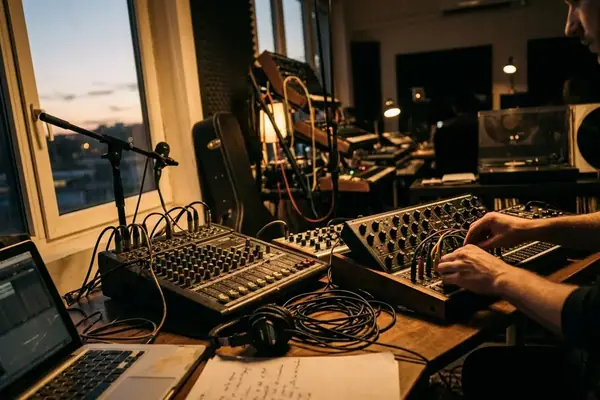
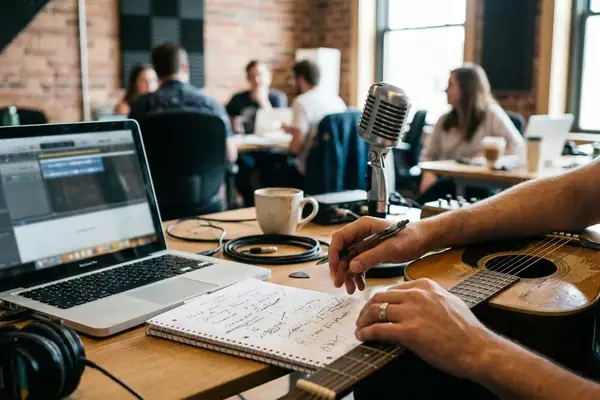
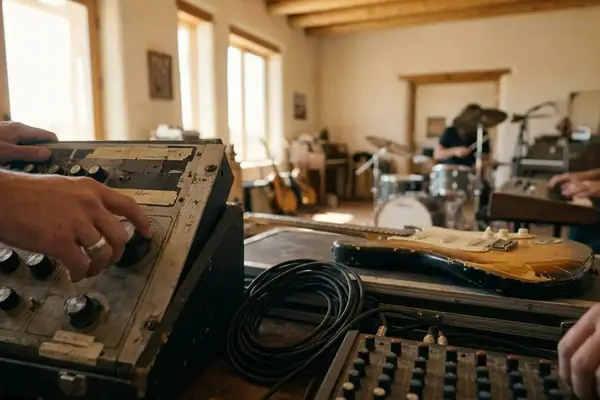
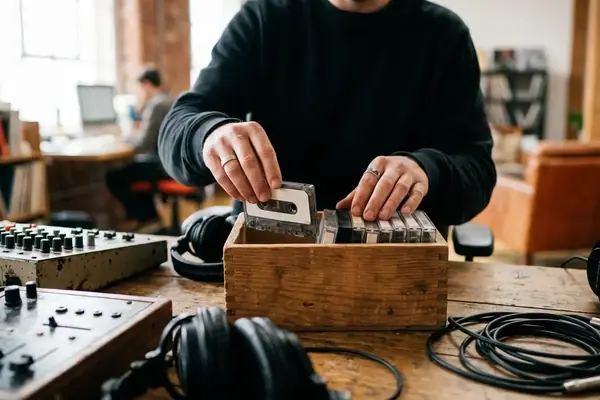
A prompted playlist is an automated sequence of tracks a model assembles after reading a few lines of text: a setting, a weather condition, a mood, a time of night. The listener types quiet desert drive, then a noisy arrival, and a tool returns an ordered set of songs that approximates that arc. The mechanism is fast, legible, and genuinely useful for passive listening.
These tools scale mood-matching efficiently. They fail at cultural context and underground discovery, because independent music travels through relationships among artists, rooms, recordings and listeners, and sonic resemblance alone never establishes those relationships.
What a Prompted Playlist Actually Does With "Quiet Desert Drive"
Run the test honestly. A five-to-ten-minute trial is enough to confirm whether the returned sequence follows the requested shape: low and spacious at the start, loud at the turn. Often, the sequence clears that bar. Since Spotify's rollout of AI-prompted playlists normalized the format, the mood-arc has become something listeners expect a machine to handle competently.
What that same trial cannot do is tell the listener which of those artists shared a bill in a converted garage, who traded home recordings through the mail, or which guitarist learned the tone from a tape that circulated among forty people and stopped. The prompt specifies an arc. It does not specify a scene.
Scene connectivity — who played with whom, who recorded in whose front room, who pressed a hundred copies and sold them at the merch table — is the substrate independent discovery grows from. A sonic-similarity engine reads the surface of a recording and infers kinship from texture. A curator reads the lineage and verifies it.
The Catalog Has No File for a Cassette That Never Shipped
Catalog-based recommendation draws on four inputs: available track information, listening behavior, genre labels, and in some systems an analysis of the audio itself. Each input is a form of quantification. The machine curates what has already been counted.
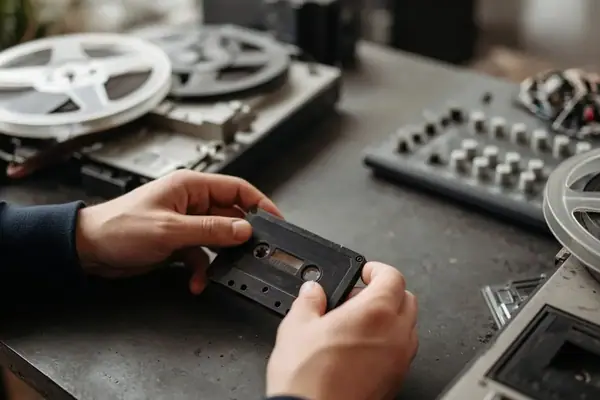
The first methodological move is an inventory of what has not been counted. Over a seven-to-fourteen-day intake audit, a curator logs every local cassette, every vinyl-only track and every artist-sent demo alongside its catalog availability. The column that matters is the empty one. An absent file offers no audio for a catalog-based tool to analyze, which means a recording can be extraordinary and simultaneously invisible.
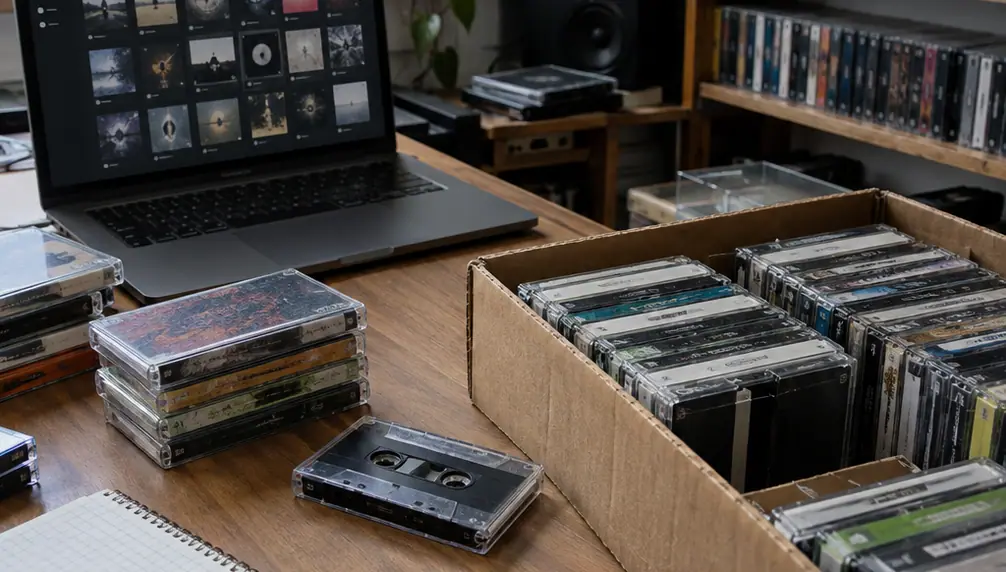
Where the Catalog Goes Dark
Supply a rough recording to an audio-aware tool and it will assess it. The same tool cannot retrieve an unreleased demo its provider has never received. That gap is structural, and no amount of prompt refinement closes it.
Texture compounds the problem. Tape hiss, room noise and a drone that holds for three minutes before a louder section arrives are precisely the qualities broad genre tags flatten. Worse, those qualities invite behavior the system reads as rejection: short listens and skips, which may weaken a track's recommendation standing. A Far West Texas desert-psych recording with a long unmoving opening gets penalized for the thing that makes it worth hearing.
Documentation beats tagging here. For that same recording, a curator notes the source format, the recording location where it has been confirmed, and the exact point where the drone gives way — information no tag reduces to "psychedelic."
Underground Radio Taught Curators to Explain the Pairing
The hand-built mix inherits a practice from late-night college radio and photocopied zines. A person hears a connection, checks its provenance, and then tells the listener why two records belong together. The telling is not decoration. It is the transfer of context that makes the pairing survive.
Consider the move a human curator makes that a BPM match cannot: placing a newly received indie track beside a verified 1970s psych recording because both approach repetition the same way, or because both were cut in a live room with the mics too far back. Shared ethos, shared method, shared stubbornness about recording space.
Rigor protects that move from becoming a flattering guess. Before the pairing note gets written, the older recording's release date and credits are checked against its sleeve or another reliable source. The newer artist is asked what actually influenced the recording, rather than having an influence asserted from sound alone. Drawing on how intake desks at small labels handle inherited claims, the asserted influence is the one that most often turns out to be wrong.
The One-Sentence Rule
For a twenty-to-thirty-minute hand-built mix, write a single sentence at each key transition naming one concrete link: a shared recording method, a local bill both artists played, or an influence the artist confirmed directly. If the sentence cannot be written, the transition has not earned its place.
This is where an independent label earns its function. Santa Rosa Records and labels like it exist to carry records that defy easy categorization through the stretch of time where no metric supports them, and a dedicated music publicist does the unglamorous work of attaching language and lineage to a release so it arrives somewhere legible. Neither role is automatable, because both depend on memory held by people who were in the room.
Three Local Anchors and One Deliberately Rough Transition
The sequence below is a template for permission-cleared material, not a list of releases claimed to exist. Fill the source descriptions with recordings actually in hand.
- Source the unquantifiable. Obtain three local anchors: a physical-only cassette rip of an ambient home recording made at an Alpine home studio; an unreleased fuzz-garage demo sent directly by an artist rehearsing near Marfa; a vinyl-only psych track connected to a small room near Fort Davis. None of the three needs to exist in a streaming catalog, and the point is that at least one should not.
- Sequence by narrative tension. Place the garage demo immediately after the ambient cassette piece. Do not smooth the seam, do not crossfade, do not match levels. The abrupt entrance supplies the tension. Close with the vinyl-only psych track, which carries the set outward rather than resolving it.
- Clear the details before publishing. Spend thirty to forty-five minutes confirming permission to use and describe each recording, its source format, and its place details. This step is the one most often skipped and the one most likely to cause harm.
- Write the liner note as connective tissue. One sentence per seam, naming what the listener is crossing.
The hiss begins in an Alpine home room; the next track breaks that stillness with a Marfa-area rehearsal take. The closing record carries the set toward Fort Davis.
Permission Before Place Names
Retain each geographic reference only after the artist confirms the recording and scene connection. A place name that an artist has not verified is a fabrication with a map attached, and it travels further than a correction ever will.
Run that four-step build and the resulting twenty-five minutes contains three things no prompt can generate: a file the catalog has never held, a transition engineered to be uncomfortable, and three sentences of verified provenance. Swap in the cassette on the desk right now, the demo in the inbox, the record bought at a show last month. The method transfers. The recordings are the part only the curator can supply.